
01 / Federal Opportunity Brief
DA01--Appeals Innovation and Integration Services (AI2S) RFI (VA-27-00017929)
02 / Federal Buyer
Who is buying?
03 / Purchase
What is the government buying?
DA01--Appeals Innovation and Integration Services (AI2S) RFI (VA-27-00017929)
The current notice is soliciting this requirement from eligible offerors.
Detailed task areas, staffing and deliverables are not included in the available text.
The notice describes a federal contracting requirement, but the complete award structure is not explicit in the indexed text.
The available description does not explain how individual work assignments will be issued.
04 / Contracting Requirements
How will this procurement work?
| Requirement | What the notice says | Source status |
|---|---|---|
| Eligibility | The available description does not state a competition restriction. | Not Disclosed |
| Contract ceiling | Not disclosed | Not Disclosed |
| Minimum guarantee | Not disclosed | Not Disclosed |
| Contract duration | Not disclosed | Not Disclosed |
| Foreign participation | Not disclosed | Not Disclosed |
| Proposal and award procedure | Detailed evaluation factors and proposal-volume instructions are not included in the available description. | Not Disclosed |
| Staffing and security | staffing; taxes or other exclusions where applicable. Nonbinding, U.S. dollars. L = Low, ML = Most likely, H = High. Technical Benchmark Table PWS: 5.2.2.7; 5.2.3; 5.2.3.1 5.2.3.3; 5.7.1 5.7.2; 5.7.4 Describe how your solution would integrate and p | Partially Confirmed |
Read the original SAM.gov description
Request for Information Appeals Innovation and Integration Services (AI2S) VA-27-00017929 Introduction This Request for Information (RFI) is for planning purposes only and shall not be considered an Invitation for Bid, Request for Task Execution Plan, Request for Quotation or a Request for Proposal. Additionally, there is no obligation on the part of the Government to acquire any products or services described in this RFI. Your response to this RFI will be treated only as information for the Government to consider. You will not be entitled to payment for direct or indirect costs that you incur in responding to this RFI. This request does not constitute a solicitation for proposals or the authority to enter into negotiations to award a contract. No funds have been authorized, appropriated or received for this effort. Interested parties are responsible for adequately marking proprietary, restricted or competition sensitive information contained in their response. The Government does not intend to pay for the information submitted in response to this RFI. The North American Industry Classification System (NAICS) for this requirement is 541519 with a size standard of $34 million. 2. Submittal Information: All responsible sources may submit a response in accordance with the below information. There is a page limitation for this RFI of 15 pages. The Government will not review any other information or attachments included, that are in excess of the 15 page limit. NO MARKETING MATERIALS ARE ALLOWED AS PART OF THIS RFI. Generic capability statements will not be accepted or reviewed. Your response must address capabilities specific to the services required in the attached PWS and must include the following: Interested Vendors shall at a minimum, provide the following information in the initial paragraph of the submission: Name of Company Address Point of Contact Phone Number Fax Number Email address Company Business Size and Status NAICS code(s) Socioeconomic data Unique Entity Identifier (UEI) Number Existing Contractual Vehicles (GWAC, FSS, or MAC) Provide a summary of your capability to meet the requirements contained within the draft PWS for the following areas: Can a single SaaS/COTS solution meet all PWS requirements across the five capabilities (Workflows, Document Review, Hearings, DCD, and BIR)? Would a single prime contract or modular acquisition yield better value and manageable integration risk? What are the key benefits, risks, and trade-offs of integrating multiple SaaS/COTS solutions versus developing a single custom application, considering user experience, integration complexity, auditability, release coordination, testing, support, total cost of ownership, and end-to-end contractor accountability, while maximizing SaaS/COTS capabilities, minimizing custom development, and ensuring seamless integration without manual hand-offs, duplicate data entry, or a fragmented user experience for Board personnel? (PWS: 3.2; 5) Can all five capabilities be delivered as vendor-hosted SaaS without VA-provided hardware, VAEC compute/storage, or middleware? For any VA-hosted elements, identify sizing, hosting boundary, connectivity, security authorization, support ownership, and estimated Government costs. (PWS: 3.2; 5.2.1.1; 5.2.1.7; 6.1) What are the capabilities of workflows, routing rules, fields, templates, and reports that VA business administrators can configure or modify without vendor development or intervention? Identify any limitations, risks, training, or dependencies associated with administrator-managed changes, including governance and approval requirements, testing and validation, rollback capabilities, release lead times, support implications, and licensing constraints. (PWS: 3.3; 5.2.2.6; 5.2.5.1) Can the Document Review/Reader (eDiscovery) capability be deployed before other capabilities and without integration with the existing Caseflow system? If so, describe the interim approach for user access, case association, document retrieval, permissions, annotations, search, and navigation. Identify the earliest feasible deployment timeframe, prerequisites, risks, limitations, and potential rework required for future integration. (PWS: 4.2; 5.2.3; 5.3; 5.4) Identify native capabilities and those requiring separate tools for OCR, handwriting recognition, duplicate detection, classification, annotation, relevance assessment, and summarization. Explain how existing OCR text and metadata can be ingested from third-party repositories to avoid unnecessary reprocessing. Address accuracy validation, source citations, human-in-the-loop controls, auditability, privacy protections, and per-page or per-transaction costs, distinguishing ingestion costs from new OCR processing costs. (PWS: 5.2.1.8; 5.2.3.5) What is a reasonable timeline to achieve full production deployment and migration of Caseflow and VACOLS? Is VA s target of within 12 months feasible? Assess the feasibility of an accelerated implementation, including integration, VA ATO, data migration, testing, training, and cutover. Provide a realistic timeline with key milestones, dependencies, risks, and opportunities to accelerate delivery. Identify the earliest achievable date for full operational capability and any factors that could delay implementation. If the 12-month target is not feasible, identify the limiting constraints and propose an alternative timeline, including key milestones and assumptions. (PWS: 4.1 4.2; 5.3 5.4) What milestone-based payment structure would you recommend? Discuss common commercial payment terms for implementation and deployment of an enterprise-wide solution of similar size and complexity for a federal agency. Describe the proposed milestone-based payment schedule for building and deploying this solution, identifying the measurable deliverables and VA acceptance criteria that would trigger payment at each stage, including development, integration, migration, testing, and production deployment. Recommend when SaaS licensing and operational charges should begin for phased releases to avoid production-level costs during development, minimize VA financial risk, and incentivize full deployment within 12 months or sooner. (PWS: 4.1 4.2) Describe your approach for migrating active and historical Caseflow/VACOLS data, including records, task and state transformations, identifiers, histories, roles, hearings, decisions, and annotations. Address the estimated duration, level of effort, constraints, common causes of delay, and key risks. Explain how you would execute cutover while maintaining service availability, minimizing parallel operation of legacy and new systems, and avoiding carryover of legacy system dependencies. (PWS: 5.4; Appendix A; Appendices C G) Describe the current security and authorization status of each proposed product, including compliance gaps, required remediation, and realistic timelines for VA ATO approval and network connectivity. Per VA guidance, proposed solutions are not required to be FedRAMP authorized but must meet applicable NIST and VA security requirements and obtain a VA Authority to Operate (ATO). List any current security frameworks that the products have (FedRAMP, StateRAMP, NIST, SOC-2, current governmental ATO s, etc) Identify any PWS security requirements that need clarification or unnecessarily restrict commercial solutions while maintaining mandatory federal and VA security controls. (PWS: 5.2.1.5; 5.8; 6.1 6.3) Identify up to five recommended PWS changes, expected effect on competition and cost, and additional information VA should provide to support a reliable proposal. For recommendations, cite the PWS section, provide specific replacement targets or wording, and explain cost, schedule, security, operational, and competition implications. (PWS: 3.2; 4.2; 5.2 5.9) Provide the following additional information in the Government-provided Vendor Response Worksheet: (Not Included in Page Count) Capabilities Worksheet PWS: 3.1 3.3; 5.2 For each of the five capabilities (Workflows, Document Review, Hearings, DCD, and BIR), identify which Section 5.2 requirements can be met through SaaS/COTS and how many require custom development. Classify each subsection using one of these categories: Native: met out of the box by the SaaS/COTS product. Configuration: met through no-code or low-code configuration. Third-party integration: met through a separate SaaS/COTS product or service integrated with the core product, or an existing VA capability. Custom development: requires new code, extensions, or materially modified commercial functionality. Unsupported: cannot be met as written. Where a subsection contains requirements in more than one category, give the predominant category and list the exceptions. Any requirement you do not list is treated as met Native or by Configuration. For each capability, provide: The SaaS/COTS products used. The approximate percentage of requirements in each category, and whether the percentage is by requirement count or by effort. For Configuration items: the estimated effort and time to deploy. For Third-party integration items: the estimated effort and schedule to integrate and configure. For Unsupported items: why commercial capabilities cannot meet the requirement, and any recommended PWS revision. For Custom development items: the estimated development effort, schedule, and cost range (nonbinding ROM). Denote any requirements that depend on a commercial roadmap feature that is not yet generally available, with the expected release date. ROM Pricing PWS: 5.2.1.1; Appendix A Provide nonbinding ROM ranges in U.S. dollars with assumptions and exclusions. Distinguish contractor-provided SaaS charges from Government-funded Veterans Affairs Enterprise Cloud (VAEC) or other enterprise costs. Describe the named, concurrent, role-based, enterprise, and consumption licensing models for approximately 2,000 users. Include UAT/training environments, storage, API calls, OCR, and AI. Include minimums, overages, growth assumptions, discounts, and price escalation for all SaaS products involved. Provide: low / most-likely / high range; licensing units and consumption volumes; assumptions regarding approximately 2,000 users; source evidence remaining in VA repositories; escalation and growth rates; implementation staffing; taxes or other exclusions where applicable. Nonbinding, U.S. dollars. L = Low, ML = Most likely, H = High. Technical Benchmark Table PWS: 5.2.2.7; 5.2.3; 5.2.3.1 5.2.3.3; 5.7.1 5.7.2; 5.7.4 Describe how your solution would integrate and perform with a large third-party evidence repository, for example the Veterans Benefits Management System (VBMS) Claims Evidence repository. Address evidence files up to 4 GB, case collections up to 1.2 TB, and approximately 6.4 petabytes (PB) of referenced source content. State how the solution avoids unnecessary duplication of source files. Cover repository access methods, caching, indexing, and concurrent users. Address the metrics in PWS Section 5.7 and industry metrics, and be sure to include: Processing times: time from retrieval to reviewable, searchable, and OCR-complete, by file-size tier. Include throughput (pages or documents per hour), queue delays, OCR accuracy, and reprocessing rules. Viewing response time: time to first-page render by file-size tier (under 10 MB, 10 100 MB, over 100 MB), sequential document loading, search response (typical case and large multi-GB case), and screen load time. Specify cached versus uncached and cold versus warm conditions, and how much of the time depends on the source repository s response. Review support: capabilities that extract dates, organize evidence into chronological timelines, identify relevant information, and reduce manual review, including TAR 2.0 and AI-assisted features. Scale and service levels: realistic service-level targets and testing methods at peak concurrent users. Include scalability constraints, and the storage, licensing, and op
05 / Historical Spending Trend
How has spending on the selected comparable contracts changed?
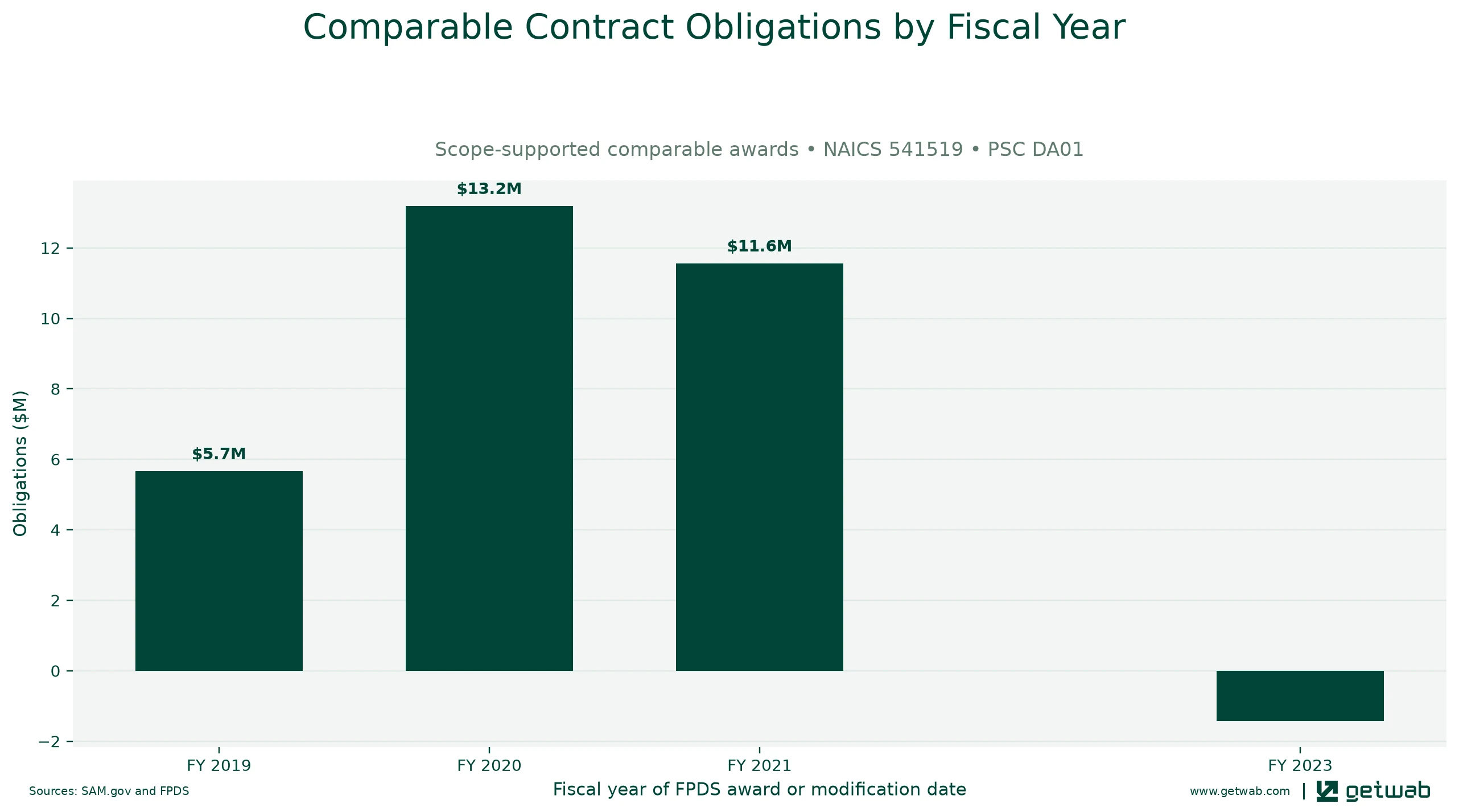
The same closed fiscal-year window and the same complete comparable-contract set are used throughout this Brief. Net obligations total $28.98M across 4 fiscal years.
| Fiscal year | Comparable obligations | Actions | Vendors |
|---|---|---|---|
| FY 2019 | $5.66M | 3 | 1 |
| FY 2020 | $13.19M | 4 | 1 |
| FY 2021 | $11.56M | 4 | 1 |
| FY 2023 | -$1.43M | 2 | 1 |
06 / Related Historical Awards
Which contracts support the comparison?
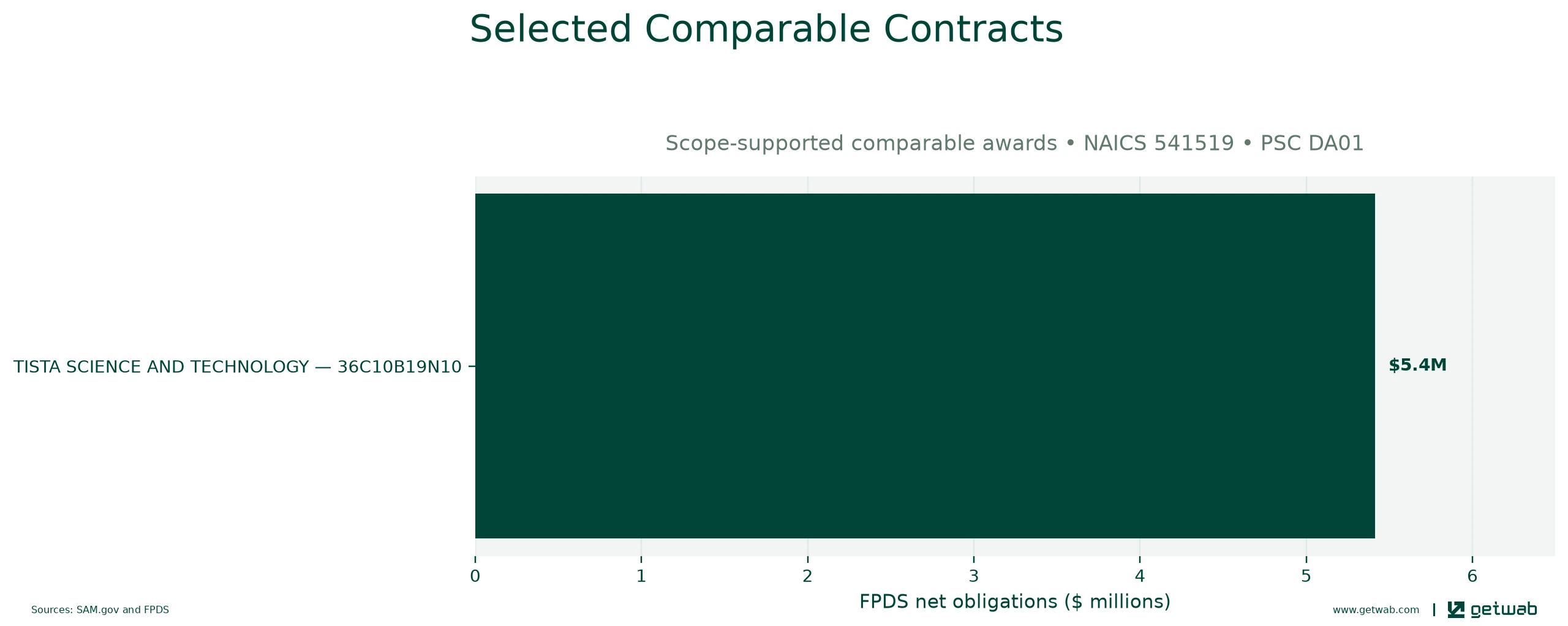
No direct contract reference was found. 2 broad matches are shown as supporting context.
| Contract | Vendor | Latest activity | Office | NAICS / PSC | Match | Obligations | Actions |
|---|---|---|---|---|---|---|---|
| 36C10B19N10050015 | TISTA SCIENCE AND TECHNOLOGY CORPORATION | Jul 25, 2019 | TECHNOLOGY ACQUISITION CENTER NJ (36C10B) | 541512 / D399 | Broad match Buyer and requirement-language evidence | $5.41M | 1 |
| VA11816F10050003 | TISTA SCIENCE AND TECHNOLOGY CORPORATION | Jan 28, 2019 | TECHNOLOGY ACQUISITION CENTER NJ (36C10B) | 541512 / D318 | Broad match Buyer and requirement-language evidence | $0 | 1 |
07 / Contractor Evidence
Which contractors have performed related work?
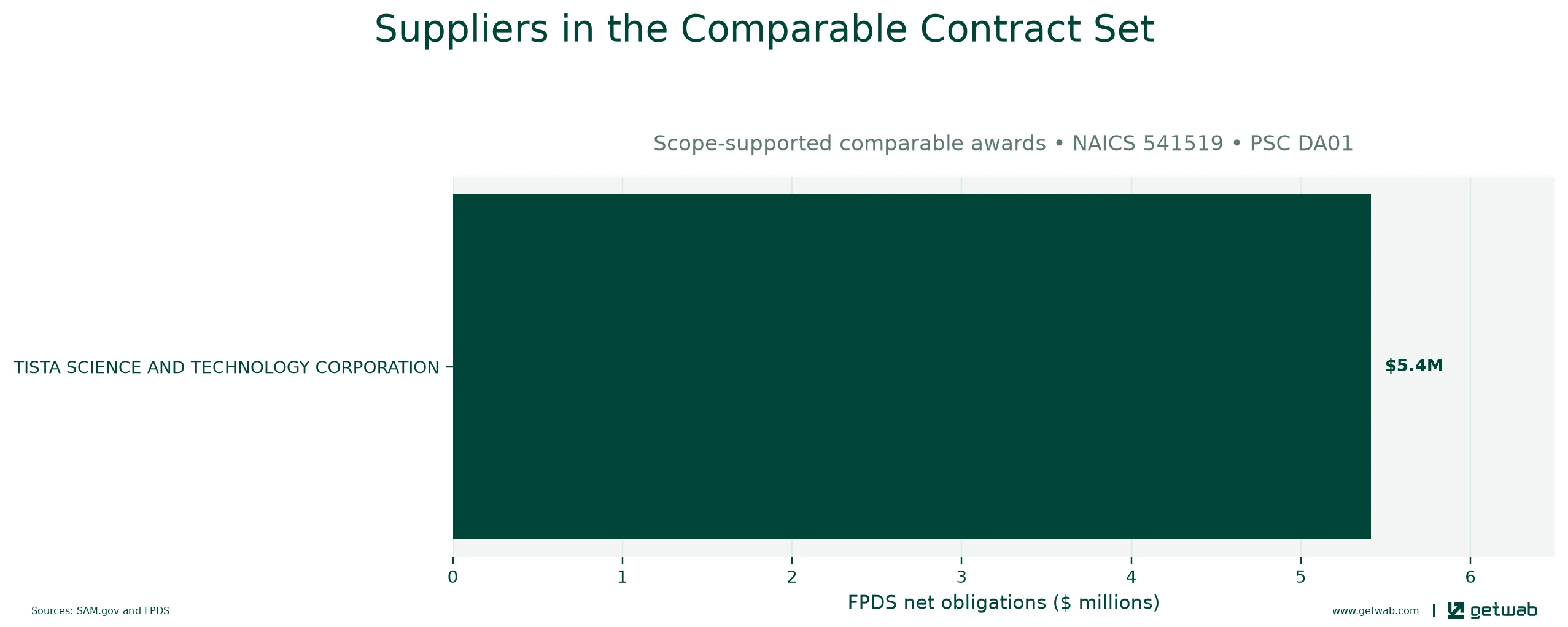
Historical contractors are ranked by direct procurement-family evidence and comparable contract activity. The table distinguishes connected holders from broader performers without identifying unverified bidders.
No directly connected predecessor was identified. The companies below are historical performers selected from the comparable contract set; none is identified as a bidder.
| Company | Evidence | Fit | Why included | Contracts | Actions | Obligations | Latest activity | Links |
|---|---|---|---|---|---|---|---|---|
| TISTA SCIENCE AND TECHNOLOGY CORPORATION UEI L73LKJ1JCVM7 · CAGE 4A0N5 | Broad historical performer Historical performer | Moderate | Comparable buyer and requirement history | 2 | 2 | $5.41M | Jul 25, 2019 | GETWAB profile Verified via SAM Entities Official website |
08 / Competitive Landscape
How was comparable work competed?
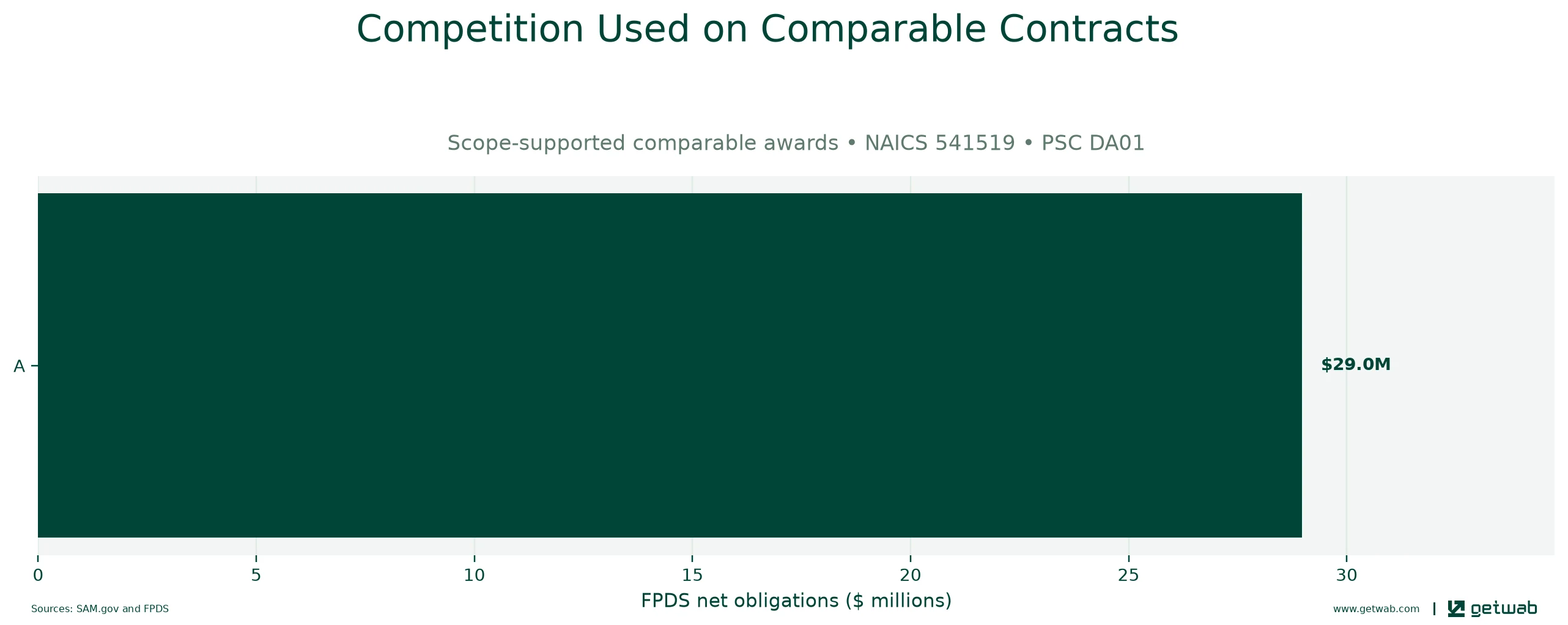
Competition treatment is calculated from exactly the same closed-period contract set used in Sections 5–7. It describes historical actions, not the outcome of this solicitation.
| FPDS treatment | Code | Actions | Obligations | Share |
|---|---|---|---|---|
| Full and open competition | A | 13 | $28.98M | 100.0% |
09 / Procurement History
How was this opportunity published and updated?
One SAM.gov notice record was resolved for this procurement family.
| Notice | Type | Posted | Response deadline | Status | Official source |
|---|---|---|---|---|---|
| 36C10B27Q0141 Current Brief record DA01--Appeals Innovation and Integration Services (AI2S) RFI (VA-27-00017929) | Sources Sought | Nov 24, 2026 | Dec 21, 2026 12:00 PM GMT-0500 | Active | View on SAM.gov |
10 / NAICS and PSC Market Context
How large is the selected comparable market?
Classification codes organize the evidence; they do not prove that every contract in the broader NAICS or PSC market matches this requirement.
11 / Capture Signals and Risks
What should be validated before committing capture resources?
Capture signals separate verified procurement-family evidence from unresolved requirements and market-only indicators.
Direct procurement-family evidence
No direct award record found
Buyer proximity
2 comparable record(s) share the contracting office
Eligibility
Not disclosed in the indexed notice
Unresolved requirement fields
7
12 / Who Should Pursue
When does this opportunity fit?
- Your team can demonstrate recent, relevant delivery in DA01--Appeals Innovation and Integration Services (AI2S) RFI (VA-27-00017929).
- You can perform under the stated acquisition model: The notice describes a federal contracting requirement, but the complete award structure is not explicit in the indexed text.
- You can show credible past performance for TECHNOLOGY ACQUISITION CENTER NJ (36C10B) or a closely related federal customer.
- Your technical scope fits, but you lack demonstrated history with TECHNOLOGY ACQUISITION CENTER NJ (36C10B).
- You need a specialist teammate to close unresolved staffing, security, or detailed-scope requirements before committing.
- Your delivery model cannot support the stated contract vehicle or order-based work structure.
- The unresolved requirements shown above cannot be validated before committing proposal resources.